
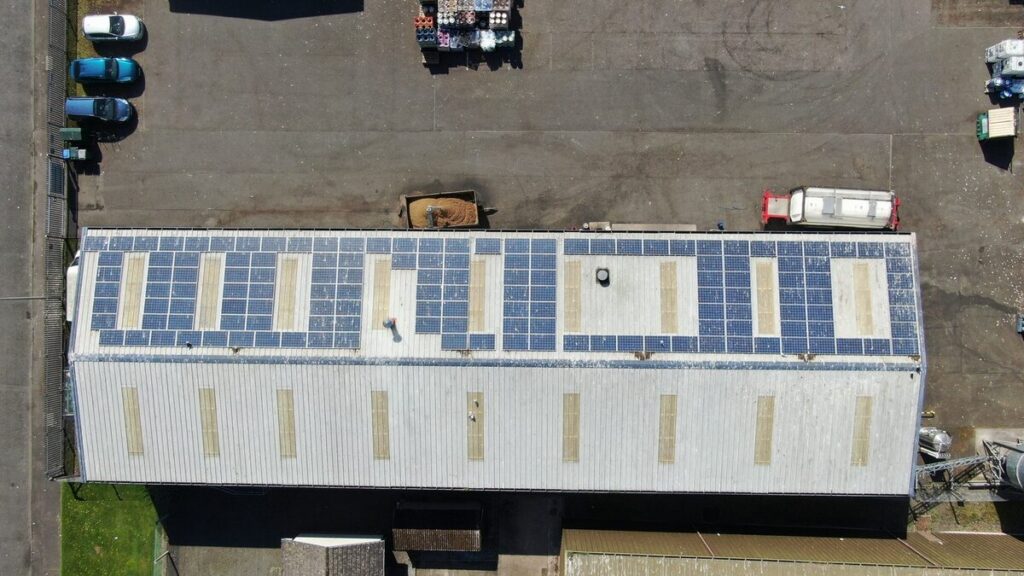
A commercial warehouse roof — where heating load and solar generation meet
Solar has one serious limitation: if your building is heated by gas, solar does nothing for your heating bill. Not “not much” — nothing. It doesn’t matter how many panels are on the roof or how much you generate on a sunny day. A gas boiler burns gas. Solar generates electricity. The two never meet.
That sounds obvious, but it’s worth saying, because heating is often the single biggest chunk of a commercial energy bill, and it’s the one part solar can’t touch on its own. The only way to bring heating into reach of your own generation is to change what heating runs on — which, in practice, means a heat pump. This chapter is about that decision: what a heat pump actually changes, what it doesn’t, and why the equation looks different once solar is generating on the roof above it.
There’s a lot of woolly thinking about this — plenty of it aimed at homes, where the debate about which houses “suit” a heat pump and which don’t gets rehearsed endlessly. The technical answer, for a home or a commercial building, is that a heat pump can heat any building, provided it’s sized to match that building’s heat loss. Undersize it and it’ll struggle on the coldest days. Size it properly and it works, full stop. Suitability isn’t really a property of the building — it’s a property of whether the design work was done properly before the unit went in.
That said, homes aren’t what this chapter is about. Commercial buildings raise a different set of questions, and they should be looked at separately rather than importing assumptions from the domestic debate.
A house needs to feel comfortable most of the time someone’s in it, and heat pumps are generally well suited to that: they run steadily, at a lower flow temperature, keeping a space at a stable temperature rather than blasting it warm and letting it cool. A commercial building is often a different problem. It doesn’t need to feel “cosy” in the way a living room does — it needs to be usable, at the right temperature, for the hours it’s occupied. And plenty of commercial spaces are large: a workshop, a warehouse, a sports hall — spaces that sit empty and cold overnight and need heating quickly once people arrive.
That rapid heat-up requirement is the genuine design question for commercial heat pumps, not whether they work in principle. It’s solvable — through correct sizing against the building’s heat loss and occupancy pattern, appropriate output capacity, and controls that pre-empt occupancy rather than react to it — but it needs someone who understands the building’s actual usage pattern to design it properly. A heat pump sized like a domestic install and dropped into a large, intermittently-occupied commercial space is where the “heat pumps don’t work for buildings like mine” complaints usually come from. That’s a sizing failure, not a limitation of the technology.
Start with the numbers most people are shown, because they’re the ones that shape the decision before solar even enters the conversation.
Under the current Ofgem price cap (July–September 2026), gas costs around 5.7p per kWh and electricity around 24.7p per kWh — electricity is roughly four times the price of gas, unit for unit. A heat pump is far more efficient than a boiler (it moves heat rather than generates it, typically delivering 3–4 kWh of heat for every 1 kWh of electricity it uses), but that efficiency doesn’t fully close a four-times price gap.
| Heating system | Tariff | Est. annual running cost* |
| Gas boiler | Standard | £760 |
| Air source heat pump | Standard variable | £1,450 |
| Air source heat pump | Off-peak / smart tariff | £640 |
*Figures are DESNZ/Ofgem modelled costs for a typical household-scale system, shown for illustration. Commercial contracts and consumption patterns vary, but the roughly 4:1 gas-to-electricity price ratio is a reasonable working assumption for most UK businesses too.
That’s the honest picture on paper: a heat pump is not automatically cheaper to run than gas, and tariff choice matters as much as the equipment. Anyone telling you a heat pump is a straightforward money-saver without asking what tariff you’re on, or could be on, is skipping a step.
This is where solar changes the maths — not by making grid electricity cheaper, but by taking a share of your heat pump’s demand off the grid altogether.
The mechanism is what we call behind the meter. The meter measures what crosses the boundary between your building and the grid. Electricity generated by your panels and used on-site, in the same moment, never crosses it — so it’s never billed at 24.7p, or whatever your commercial rate happens to be. It’s already paid for through the panels. Once the system has paid for itself, the marginal cost of that electricity is close to zero.
A heat pump is a reasonable match for solar’s timing, if it’s run to fit it. Heat pumps often run water heating and pre-heat cycles during the day, and a business is occupied and drawing other loads through daylight hours anyway — lighting, machinery, computers, refrigeration. That’s exactly when panels are generating.
This isn’t automatic. It depends on sizing the system to the building’s actual usage pattern, heat pump included, rather than just filling the available roof. That’s the same lesson behind every commercial solar job I’ve quoted: usage pattern determines what’s worth building, roof space only determines what’s physically possible. If an installer quotes a system size before asking how the heat pump will run and when, that’s a sign they’ve measured the roof and not the building.
The Future Homes Standard comes into force on 24 March 2027, with a transitional period to 24 March 2028 for developments already in the pipeline. It requires new homes to be built without fossil fuel heating, and developers will need to pair heat pumps with solar PV covering roughly 40% of ground floor area where feasible. In effect, government is now specifying heat pump and solar together, as one system, rather than as two separate purchases.
It’s worth being clear about what this doesn’t mean. This standard applies to new-build housing, not to existing commercial buildings. Earlier proposals for a 2035 phase-out of gas boilers have been dropped, and there is no confirmed date forcing existing gas systems out. If your gas boiler is working and you’re not planning to replace it, nothing here obliges you to change now.
The relevant point for this chapter isn’t the mandate — it’s the direction of travel. Heat pump and solar are increasingly designed as a single system. That’s worth knowing before a failed boiler forces the decision on someone else’s timeline rather than yours.
Households have some protection built in: the Ofgem price cap currently sits at £1,862 a year for typical dual-fuel usage (July 2026). There is no equivalent ceiling for businesses. If wholesale prices spike the way they did in 2022, a business absorbs that in full — on gas or on electricity.
That’s why this decision shouldn’t be judged purely on this year’s running cost. The real value of solar is that self-generated electricity is the one price a supplier can never raise. It matters less whether a heat pump is marginally cheaper or more expensive than gas at today’s rates, if a meaningful share of what it uses is generated on your own roof at a cost that’s already fixed.
If a boiler is due for replacement, it’s worth having someone look at the building’s usage pattern, the roof, and the heating load together — not price the boiler and the panels separately. Priced apart, they tend to add up to more than one system that’s been sized around the other. That’s the conversation worth having before the decision gets made for you by a boiler that’s already given up.
Would a heat pump and solar actually stack up for your building?
Take the free 2-3 minute Commercial Solar Suitability & ROI Scorecard and find out where your site stands. Take the Free Scorecard →