
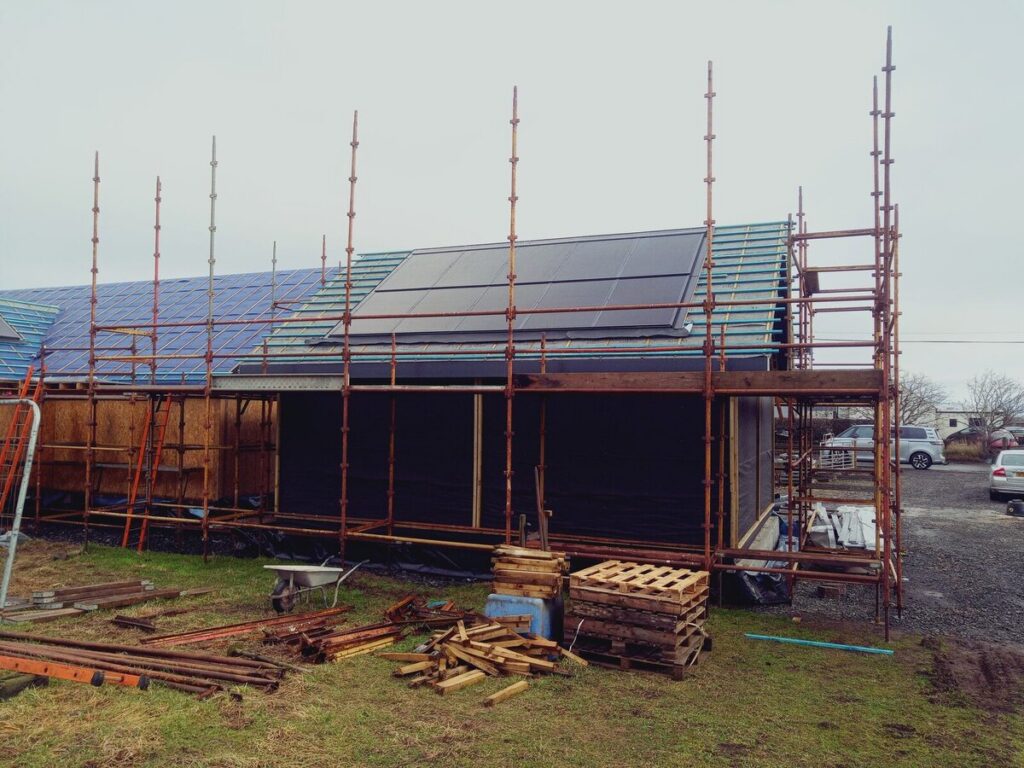
Roofing and solar going on together — the scaffolding tells the story
Most people never think about their roof. That’s not a criticism — it’s actually the roof doing its job properly. A roof has one task: keep the building dry. When it’s doing that, it’s invisible. Nobody walks round the building admiring the roof. It’s out of the way, rarely looked at, and — usefully for solar — higher up than almost anything else on the site, which means it’s far less likely to sit in the shadow of a tree or a neighbouring structure than ground-mounted panels would be.
The only time most business owners give their roof any thought at all is when it stops doing that one job. A leak, a damp patch spreading across a ceiling tile, water coming through somewhere it shouldn’t — that’s when the roof suddenly becomes the most important part of the building. The rest of the time, it’s simply wasted space, sitting there doing nothing more interesting than keeping the weather out. That’s exactly why it’s such a good place for solar. But it’s also why so few people think properly about how the two interact before they commit to an install.
Something to consider before any commercial solar install goes ahead: solar panels and roofs don’t age at the same rate. Most solar panels today carry a 25-year warranty to operate at 80% of their original capacity — a genuinely long-term investment. Roofs, depending on the type, generally last somewhere in the range of 40 to 50 years.
That’s fine if the solar panels are going on a brand new roof, but that’s often not the case. If a roof is already, say, 40 years old — still in reasonable condition, but realistically going to need replacing within the next 10 to 15 years — that timeline matters enormously. Fit solar onto that roof without accounting for it, and you’re setting up a re-roofing job partway through the solar system’s warrantied life.
That’s not a disaster. Panels can be removed and refitted once a new roof goes on beneath them. It’s a well-understood, entirely doable piece of work. But it comes with a cost that nobody enjoys discovering after the fact — and it’s a cost that a slightly more honest conversation, right at the start, could have flagged.
I’ve had jobs where the state of the roof was bad enough that I’ve told the customer, plainly, that the roof needed replacing at the same time as the solar went on — not because it was the more expensive option for us, but because doing it any other way would almost certainly cost them more over the life of the system.
Some customers have taken that advice, and ended up with a fully warrantied new roof and a solar system installed together, cleanly, with none of the later complications. Others have taken a cheaper quote elsewhere, from someone willing to fit panels onto a roof that probably shouldn’t have had anything fitted to it yet. I don’t know how those particular jobs have gone since, but I’d be surprised if most of them don’t end up paying more in the long run — through an earlier, more disruptive re-roof, or through problems that a tired roof was always going to develop once it had panels bolted to it and people walking across it during installation.
I’d rather lose the job than win it by staying quiet about something I could see plainly from the roof itself.
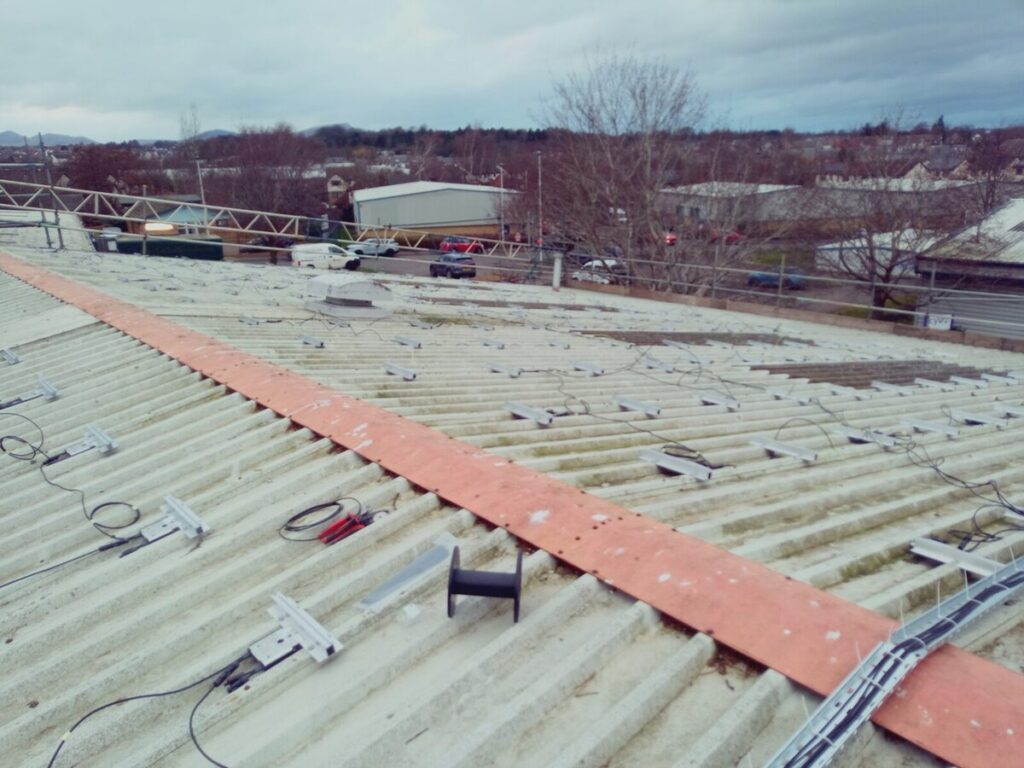
Getting the roof right first — mounting rails going down before a single panel is fitted
There’s a common assumption in this industry that the solar panels themselves are “the easy bit,” while the electrical side — inverters, wiring, connections to the grid — is where the real complexity lives. I understand why people think that. Electrical work looks technical, and looks are persuasive.
In my experience, it’s the other way round. The electrical side, while it certainly isn’t trivial, tends to be fairly repeatable from job to job. An inverter is an inverter. A connection to the consumer unit follows broadly similar principles wherever you are. The roofing side is nothing like that consistent. Roof size, pitch, covering type, age, structural condition, access — every one of these varies significantly from building to building, and each variation changes what’s actually safe and appropriate to do. Add in the genuine dangers of working at height, and the roofing side of a solar install is, if anything, the more demanding half of the job, not the easier one.
That’s why I’ve come to a fairly simple rule: solar panels should be fitted by people who genuinely know roofs — proper roofers — not by electricians, and certainly not by labourers hired in to speed up an install. The electrical connection is a job for an electrician. Everything that happens on the roof itself is a job for a roofer. Roofers on the roof, electricians at the fuse board. It’s a simple enough principle, but it’s one a surprising number of installs still get backwards.
If you’re a business owner considering solar, ask two questions before anything else: how old is my roof, realistically, and who is actually going to be doing the work up there? The answers to both will tell you more about how this install is likely to go than almost anything else in the quote.
Not sure what state your roof is really in?
Take the free 2-3 minute Commercial Solar Suitability & ROI Scorecard and find out where your site stands. Take the Free Scorecard →