
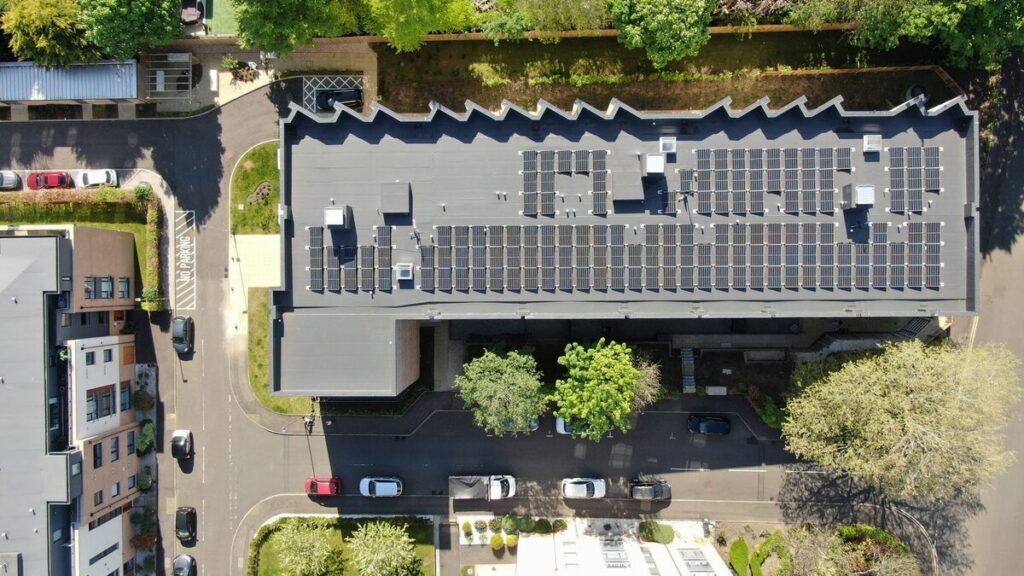
A commercial car park with rooftop solar — the setting for daytime EV charging
Every business and homeowner with an EV parked on the drive or in the car park has had roughly the same thought at some point: I’ve got solar, I’ve got an electric car, surely one just charges the other. It’s an intuitive idea, and it isn’t wrong exactly. It’s just considerably less simple than it sounds, and the details matter more than most people realise before they’ve spent money assuming otherwise.
If your EV is parked at home during the day, solar can charge it properly, and some manufacturers — Solaredge and Myenergi among them — make chargers that talk directly to your solar inverter, so the whole thing happens automatically without you needing to think about it. That’s a good, real setup, when it applies.
The trouble is that it only applies if the car is actually sitting on your drive while the sun’s out. If you drive it to work every day, the panels are generating precisely when the car isn’t there to use it.
There’s also a mismatch in scale that’s worth seeing rather than just being told about. A typical single-phase domestic solar system peaks at somewhere around 5 to 6kW on a good day, around the middle of the day. A standard single-phase EV charger, on the other hand, draws a constant 7kW whenever it’s plugged in and charging. Even at its very best moment of the day, a typical domestic system usually isn’t quite generating enough, on its own, to keep up with a single charger running flat out — let alone anything else in the house that’s drawing power at the same time.
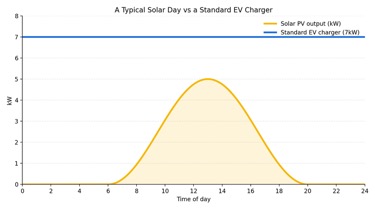
The yellow curve is a typical domestic solar day; the blue line is a standard EV charger, drawing a flat 7kW whenever it’s switched on
The chart above shows this clearly. The yellow curve is a typical domestic solar day — rising after sunrise, peaking around solar noon, fading out by evening. The blue line is a standard EV charger, drawing a flat 7kW around the clock, whenever it’s switched on. Even at the very peak of the solar curve, generation sits below what a single charger needs, and for most of the day, the gap is far wider than that.
The obvious next thought is battery storage — store the daytime generation, then empty the battery into the car once you’re home in the evening. It’s a reasonable instinct, but the numbers rarely work the way people hope. A typical domestic battery holds somewhere between 5 and 20kWh. A typical EV battery holds 70 to 100kWh. A domestic battery, even a generously sized one, is nowhere near capable of filling an EV from empty — it can offer a meaningful top-up, not a full refill. And the solar can only output at the inverter size — typically 5-6kW on a single phase domestic supply. So, some grid usage will always be required.
Whether that top-up matters much depends entirely on how far you actually drive. Someone doing a handful of miles a day, with correspondingly modest charging needs, might find solar and a battery cover most of it. Someone commuting long distances every day is going to need considerably more energy than a domestic solar-and-battery setup can realistically supply.
None of that is an argument against getting solar to support an EV — it’s a solid top-up source. It’s an argument against treating it as your primary charging method. For most people, the more realistic primary method is a cheap overnight electricity tariff — some run at around 20% of the standard rate — which also happens to be an excellent way to top up home battery storage during winter, when solar generation is at its weakest anyway. If you’re considering an EV, or battery storage, or both, checking what overnight tariffs are actually available to you isn’t optional homework. It’s essential.
For a business, the whole calculation changes shape. Plenty of businesses install EV chargers as a staff perk, or to serve visitors, with charging happening through the working day rather than overnight. Here, solar can make a real difference — but only if you actually do the maths on load versus generation, rather than assuming solar will simply absorb whatever the chargers draw.
A standard EV charger draws a constant 7kW. Five of them running simultaneously is 35kW of additional load, on top of whatever else the building is using at the time. If your solar array’s output, at that moment, is producing 35kW or more, it can cover that load. If it isn’t, it can’t, and the shortfall gets pulled from the grid as normal.
Solar generation is also intermittent by nature — it varies through the day depending on sun angle, cloud cover, and a dozen other factors, so the amount available to meet that EV load isn’t a fixed number, it moves constantly. Battery storage can help smooth some of this, but it’s capped by the output rating of the battery’s inverter, not just the battery’s total capacity. A battery with a 20kW inverter simply cannot deliver 35kW to meet that charger load, no matter how much energy is sitting stored inside it. Capacity and output rate are two different constraints, and both need checking.
None of this means solar can’t meaningfully support a business’s daytime EV charging. It means the size of the solar array, and the output rating of any battery inverter, both need to be checked against the actual expected charging load — not assumed to simply “handle it” because there are panels on the roof.
The third scenario is different again: a business with its own fleet of EVs, charged overnight once vehicles are back at base. Here, battery storage earns its place properly, since solar obviously isn’t generating overnight at all. But the same principle applies as before — battery capacity and inverter output need to be matched to the number and draw of the chargers actually in use, not oversized for the sake of it.
It’s also worth being honest about where solar fits into this picture: there’s little point specifying a large battery for overnight fleet charging if the solar array feeding it isn’t actually capable of refilling that battery day to day. An oversized battery paired with an undersized solar array just means a battery that spends much of its life partially empty. And just as with the domestic scenario, for genuinely overnight-only charging, it’s worth properly comparing the economics of a cheap overnight tariff against the cost of a large battery system before assuming the battery is the right answer at all.
Solar and EVs are a genuinely good pairing, when the numbers are actually done. But “good pairing” isn’t the same as “solar will provide all of it,” and the businesses and homeowners who get the most value out of the combination are the ones who’ve done the maths on load, generation, and battery output — rather than the ones who assumed the two would simply sort themselves out because both happen to involve electricity.
Thinking about using solar to charge your business’s EVs?
Take the free 2-3 minute Commercial Solar Suitability & ROI Scorecard and find out where your site stands. Take the Free Scorecard →