
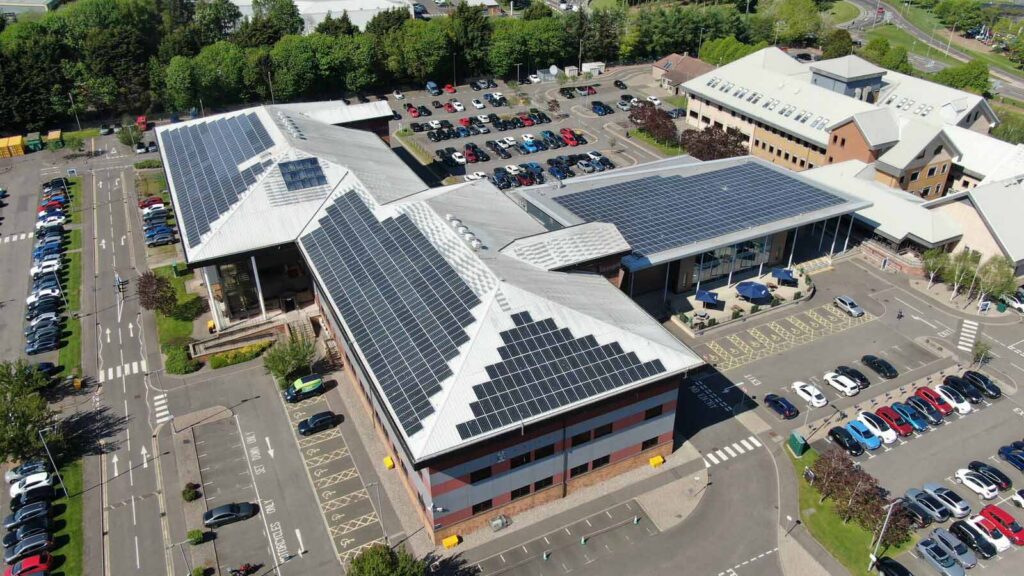
If you take one phrase away from anything I write about solar, I’d want it to be this one: “behind the meter.” It’s not a marketing term, and it’s not jargon for the sake of sounding technical. It’s the single idea that explains why some solar systems pay for themselves in four years and others take ten. I use it constantly, and I think most business owners would make better decisions if they understood what it actually meant.
Every building with a mains electricity supply has a meter, and that meter has one job: measuring how much electricity crosses the boundary between your building and the wider grid. Electricity flowing in from the grid gets counted. Electricity flowing back out, if you’re exporting surplus generation, gets counted too, usually at a different rate.
“Behind the meter” simply means anything that happens on your side of that boundary, inside your own walls, so to speak, before electricity ever needs to cross it in either direction. If you generate electricity from a rooftop solar system and use it immediately, in the same building, at the same time it’s produced, that electricity never touches the meter at all. It’s generated behind it, used behind it, and the meter never has to record the transaction.
Here’s where it gets interesting. Electricity you use behind the meter is worth the full retail price you’d otherwise have paid to import it. Electricity you export, because you generated more than you could use at that moment, is paid at a separate export rate, and that rate is almost always considerably lower than what you’d have paid to buy the same unit back.
So the same physical unit of electricity can be worth very different amounts, depending entirely on whether it’s used on-site or sent out to the grid. A solar system that manages to use 80% of what it generates behind the meter is capturing far more value than one that only manages 30%, even if both systems generate exactly the same number of kilowatt-hours over a year. The panels don’t know or care where the electricity ends up. The economics absolutely do.
This is the entire reason commercial solar so often outperforms domestic solar on paper, despite being, in engineering terms, exactly the same technology. A house is frequently empty during the middle of the day, the exact hours solar panels are generating most. Electricity gets exported because nobody’s there to use it. A business, by contrast, is often fully occupied and drawing power throughout the working day: machinery, lighting, refrigeration, ventilation, computers, whatever the operation requires. That demand lines up with generation almost perfectly, and a much higher proportion of what’s produced gets used immediately, behind the meter, at full value.
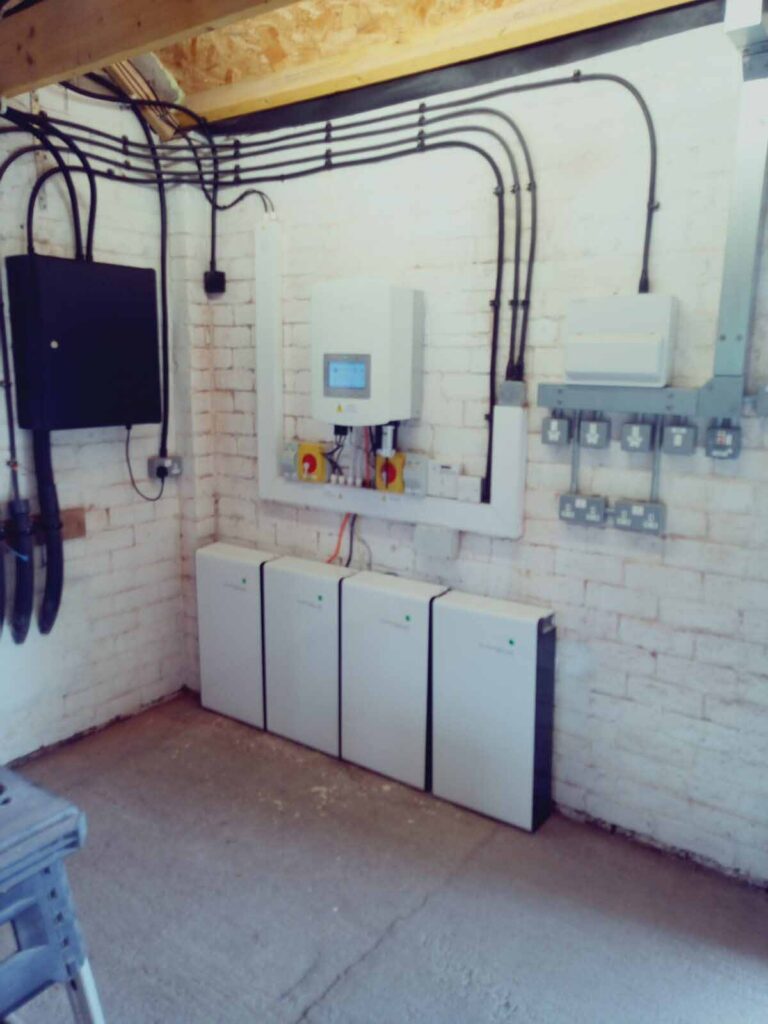
Battery storage is really just a tool for extending how much of your generation stays behind the meter. If a building generates more than it can use during sunlight hours, a battery lets you store that surplus and use it later in the day, rather than exporting it at the lower rate. Effectively, it converts electricity that would otherwise have crossed the meter and left the building into electricity that stays behind it, just at a delay.
That’s valuable, but it’s worth being clear-eyed about the order of priorities. The cheapest, simplest way to maximise behind-the-meter value is to size a system to match how a building already uses electricity, so as much generation as possible gets used directly, in real time, with no storage needed at all. Battery storage is the next-best tool for the electricity that’s left over, not a substitute for getting the sizing right in the first place. I’ve seen systems specified with a large battery bolted on to compensate for a solar array that was never properly matched to the building’s usage pattern to begin with. That’s solving the wrong problem, and usually at considerable extra cost.
If you’re a business owner getting a solar quote, the number that actually matters isn’t just the size of the system or even the total generation figure. It’s what percentage of that generation is realistically going to be used behind the meter, given how your business actually operates. A large, cheap system that exports most of what it generates can perform worse, financially, than a smaller, well-matched one that keeps almost everything behind the meter.
This is also why I’d be cautious of any solar quote that doesn’t ask detailed questions about your actual patterns of electricity use before proposing a system size. Genuine “usage first” design means understanding when your business draws power, not just how much roof space is available. The roof space determines what’s physically possible. Your usage pattern determines what’s actually worth building.
Behind the meter, in plain terms, means: generated and used on-site, without ever needing to buy it or sell it through the grid. It’s the most valuable electricity a solar system can produce, and the whole game of designing a good commercial solar system is really about maximising how much of your generation stays there, rather than crossing the meter and losing value on the way out. Everything else, panel choice, battery sizing, even roof orientation, is really in service of that one underlying goal.
How much of your own usage could sit behind the meter?
Take the free 2-3 minute Commercial Solar Suitability & ROI Scorecard and find out where your site stands. Take the Free Scorecard →